

Automatic visual inspection machine for ampoules, vials, cartridges and syringes.
The AV-E is the cutting-edge technology for the high-speed automatic inspection of pharmaceutical products such as vials, cartridges, ampoules¿ and syringes (mod. AV-EGS), ¿which represents the ideal solution to ensure that SVP products are essentially free of particulate and cosmetic defects.
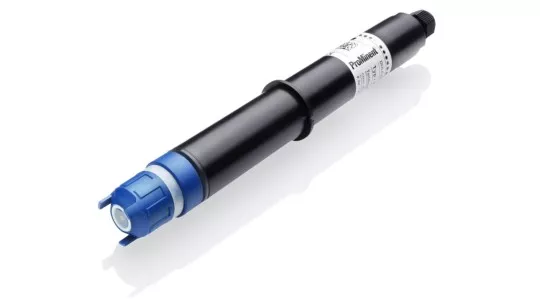
DULCOTEST
Graduated measuring ranges 0.01 – 10 mg/l
Bromine measurement with DULCOTEST sensors: Safe metering in disinfection processes with bromine. The robustness of the sensors makes them suitable for a very wide range of water qualities.
Reliable online measurement of bromine – with DULCOTEST sensors
Bromine compounds are an increasingly popular alternative to chlorine compounds in water disinfection in spite of the higher costs of the reagents.
Bromine has a number of advantages over chlorine compounds when it comes to disinfection:
- More effective disinfection at higher pH values.
- Lower volatility at higher temperatures.
- Less tendency to corrosion.
- Bromine compounds that have finished reacting (combined bromine) produce less odour and irritation of the mucous membranes.
Our product line of DULCOTEST bromine sensors provides three types of sensor for your measurement tasks.
Sensor types CBR1-mA and BCR1-mA are resistant to contaminated water and are designed for the treatment of cooling water. Type CBR1 is specifically designed for free bromine from inorganic bromination processes, e.g. sodium bromide + sodium hypochlorite, or the use of BrCl.
Sensor type BCR1-mA is optimised for the measurement of organic bromination agents (e.g. BCDMH).
Sensor type BRE3-CAN is available for the measuring and control system DULCOMARIN for treating swimming pool water with BCDMH.
Your benefits
- Precise, real-time amperometric measurement for efficient process control (short response time).
- Suitable for a very wide range of water qualities (contamination, pH, salinity, temperature).
- Amperometric measuring eliminates interference caused by turbidity or colouration.
- Stable zero point means no drift.
- Integrated temperature compensation eliminates interference caused by influence of temperature.
- Diaphragm-covered electrodes for reduced dependence on flow, substances in water and film-forming media.
Technical Info
- inorganic free bromine, e.g. using the ACTI bromine process: HOBr, or inorganically bound bromine (proprietary names include Stabrex®)
- DBDMH (1,3-dibromo-5,5-dimethylhydantoin), proprietary names include Albrom 100®
- BCDMH (1-bromo-3-chloro-5,5-dimethylhydantoin), proprietary names include Brom-Sticks®
Your benefits
- Measured variable: total available bromine from BCDMH (1-bromo-3-chloro-5,5-dimethylhydantoin)
- Diaphragm-covered sensor minimises faults caused by changing flow or ingredients in the water, N-bromamide sulfonate
- Resistance to blocking is achieved by the use of an electrolyte with an antimicrobial effect (less blocking by biofilms) and by a large-pored diaphragm (less blocking by solid particles/dirt)
- Use with high pH values by optimisation of the electrolyte diaphragm system
Your benefits
- Measured variable: total available bromine from BCDMH and other oxidative-acting bromine organic disinfectants
- Diaphragm-covered sensor minimises faults caused by changing flow or ingredients in the water
- Use with high pH values by optimisation of the electrolyte diaphragm system
- Operation on the CAN-bus with all the associated benefits
Your benefits
- Measured variable: free chlorine, as well as free and combined bromine (bromamines)
- Diaphragm-covered sensor minimises faults caused by changing flow or ingredients in the water
- Resistance to films of dirt and biofilms by electrolyte with antimicrobial effect and large-pore diaphragm
- Use at high pH value of up to 9.5 by optimisation of the electrolyte diaphragm system
Your benefits
- Measured variable: free chlorine as well as free and combined bromine (bromamines)
- Diaphragm-covered sensor minimises faults caused by changing flow or ingredients in the water
- Resistance to films of dirt and biofilms by electrolyte with antimicrobial effect and large-pore diaphragm
- Use at high pH value of up to 9.5 by optimisation of the electrolyte diaphragm system
Brand
